
The Ultimate Project Management Roadmap Guide: Your Strategic GPS for Success 🗺️

Every significant journey—from building a skyscraper to launching a new software product—requires more than just a detailed itinerary. It requires a Project Management Roadmap.
This powerful, high-level visualization is your strategic GPS, keeping all stakeholders aligned, managing expectations, and ensuring every task contributes directly to the overarching business goal. If your projects often suffer from scope creep or stakeholder confusion, the roadmap is the solution you need.
What Exactly is a Project Management Roadmap?
The Project Management Roadmap is a strategic communication tool that provides a visual summary of a project’s objectives, major initiatives, and key milestones over time.
Crucially, it is not a task list or a detailed schedule. Instead, it focuses on the “Why,” “What,” and “When” of the project, leaving the granular “How” and “Who” to the detailed project plan.
It serves as the single source of truth for executives, clients, and teams, answering the question: “Where are we going, and what’s the big picture?”
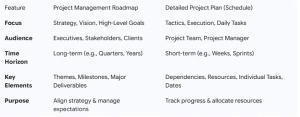
Roadmap vs. Project Plan: Clarifying the Confusion 🚦
It’s easy to confuse these two essential documents, but their difference lies in their audience and level of detail:
The 5 Essential Components of an Effective Roadmap
A successful Project Management Roadmap includes these fundamental building blocks:
- Project Vision & Goals (The ‘Why’): The overarching business value the project delivers. This must be a measurable outcome (e.g., Increase operational efficiency by 20%).
- Major Initiatives/Themes (The ‘What’): High-level work categories that group related tasks. Think of these as phases (e.g., System Discovery, Beta Testing, Go-to-Market Strategy).
- Key Milestones: Significant checkpoints that mark the completion of a major initiative or decision point (e.g., Requirements Sign-off, System Integration Complete, Final User Training).
- Deliverables: The tangible outputs of the project within the current phase (e.g., New Data Dashboard, Updated Policy Manual, Live Platform).
- Time Horizon: A flexible, high-level timeline, typically using “Now,” “Next,” and “Later” buckets or quarters, to communicate priorities without overcommitting to rigid dates.
The 4-Step Process to Building Your Roadmap 🛠️
Follow this proven process to construct a clear and actionable Project Management Roadmap:
Step 1: Define the Strategic Vision (The North Star)
Before listing tasks, define the ultimate destination. Hold a kick-off meeting with key sponsors to lock down:
- The Problem: What business pain point are we solving?
- The Goal: The desired outcome and its measurable success metrics (KPIs).
- The Scope: The high-level boundaries of the project—what’s in and, critically, what’s out (to prevent scope creep later).
Tip: Ensure the project goal directly links to a company-wide strategic objective. If it doesn’t, question the project’s viability.
Step 2: Identify, Group, and Prioritize Initiatives
Gather all the necessary work and structure it logically:
- Brainstorm: List all major initiatives, features, or phases required to reach the goal.
- Group: Organize these items into logical Themes (e.g., put all tasks related to design into a “User Experience” theme).
- Prioritize: Use a prioritization framework like MoSCoW (Must-have, Should-have, Could-have, Won’t-have) or Value vs. Effort to rank the items. This ensures you focus on the highest-impact work first.
Step 3: Plot Milestones on a Flexible Timeline
Translate your prioritized initiatives onto the visual roadmap.
- Establish Milestones: Set clear, non-negotiable achievements (e.g., a specific release or a critical approval).
- Use Time Buckets: Assign the prioritized initiatives to your time horizon. Using Q1, Q2, Q3 or Now, Next, Later allows for strategic flexibility. Initiatives in the “Now” bucket are more detailed and firm, while those in “Later” are high-level and subject to change.
- Identify Dependencies: Visually mark where one major theme cannot start until another milestone is complete. This helps highlight critical paths and resource needs.
Step 4: Communicate, Review, and Iterate (Keep it Live!)
The biggest mistake is creating a roadmap and filing it away. The roadmap must be a living document.
- Communicate Broadly: Present the roadmap to all stakeholders. Use it to tell a story about the project’s journey, focusing on the value it delivers.
- Get Buy-In: Ensure executive sponsors formally approve the roadmap—this is your defense against unauthorized changes.
- Review Regularly: Schedule a recurring review (e.g., monthly or quarterly) to update the roadmap based on actual progress, new risks, and shifts in business strategy. If a priority changes, the roadmap is the first document you update to communicate that change.
Conclusion: The Roadmap as Your Project Foundation
The Project Management Roadmap is the cornerstone of effective project leadership. It transcends the daily grind of tasks, providing the essential strategic overview that aligns every single person—from the intern to the CEO—on the same vision.
By creating and rigorously maintaining this visual guide, you replace chaos with clarity, manage stakeholder expectations proactively, and dramatically increase your project’s probability of success. Stop getting lost in the weeds; start navigating with a clear map.
Read more related blogs and stay connected with us. CLICK HERE
Recommended Resources for You

You may also like

Top 4 Short Certificate Programs That Pay Well

PMP Certification Training in Scottsdale, AZ | Certification Guide